
If your council has just written to you about new bins, a brown food caddy on the doorstep, or a different collection day, you are not alone. England's Simpler Recycling reforms are rolling out across the country through 2026, and millions of households are seeing their bin schedules change for the first time in years.
The changes are real, they affect almost every household in England, and the messaging from individual councils has been, charitably, patchy. Here is a plain-English guide to what is actually changing, when it starts where you live, and how to keep on top of a schedule that has just shifted under your feet.
What Is Simpler Recycling?
Simpler Recycling is a government reform that requires every local authority in England to collect the same core set of materials from every household by the end of March 2026. Before the reform, councils could choose what they collected and how, which is why a black bin in Leeds and a black bin in Bristol could mean two completely different things.
From 2026, all English councils must collect:
- Food waste, collected weekly
- Residual (general) waste, typically collected fortnightly
- Paper and card, collected at least fortnightly
- Plastic, metal and glass, collected at least fortnightly
- Garden waste, available on request (often a paid annual subscription)
Some councils combine paper and card with plastic, metal and glass into a single mixed recycling stream. Others keep them separate. The government has stopped short of mandating one approach, which is why the colour of your bins still depends on where you live.

The New Food Waste Bin
The single biggest visible change for most households is a new food waste caddy. Around 6 million homes in England already had separate food waste collections before the reform. By the end of March 2026, every English home should have one.
You will typically receive two containers:
- A small kitchen caddy (around 5 to 7 litres) that lives indoors, often under the sink
- A larger outdoor caddy (around 23 litres) with a locking lid, kept outside
Food waste is collected weekly, regardless of what your other bins do. That weekly frequency is deliberate. food waste rots fast, and councils want to avoid the smell and pest problems that come with leaving it out for a fortnight. The collected waste goes to anaerobic digestion plants, where it is broken down to produce biogas and fertiliser, rather than to landfill where it would otherwise release methane.
If you have not received your caddies yet and you live in England, your council should be in touch shortly. Most councils have a form on their website to order or replace caddies if yours has gone missing.
What About the Other Bins?
For most households, the rest of the schedule looks something like this after the rollout:
- General waste: fortnightly, usually a black or grey wheelie bin
- Recycling: fortnightly, with paper and card sometimes separated from plastic, metal and glass
- Food waste: weekly, in a small caddy
- Garden waste: fortnightly during the growing season, usually paid (typically £35 to £60 per year)
Many councils have used the reform as an opportunity to switch general waste from weekly to fortnightly. The argument is that with food waste collected separately every week, there is less reason to empty the general bin as often. The expected effect is more recycling, less landfill, and lower collection costs.
It also means that, for the first time, a lot of households are juggling four different bins on rotating cycles. Which brings us to the predictable problem.

The Confusion Is Not in Your Head
Even with national rules, every council is still free to choose its own bin colours, its own collection days, and its own zones. So while the materials being collected are now standardised, almost nothing else is.
In one borough, recycling might be a green wheelie bin. Next door, it is blue. Paper and card might share a bin or have their own. Garden waste might be brown, or it might be a separate green bin entirely. The new food caddy is usually green, but not everywhere.
And because most councils have changed schedules at the same time, the colour and day associations you built up over years are now actively misleading. Households that always put the black bin out on Tuesday are suddenly putting it out on Wednesday, fortnightly, and only on alternate weeks. Households that never had a brown caddy now have one, and have to remember it goes out every single week.
If you have moved house in the last year, multiply the confusion by however many councils you have lived in. The mental model resets every time.

When Does the Change Start Where You Live?
The legal deadline for the reforms was 31 March 2026 for most households in England, with some flexibility for councils that needed longer to roll out new vehicles and depots. Some areas changed in late 2025. Others are still in the middle of switching. A handful have applied for extensions into late 2026 and early 2027.
The quickest way to find your current schedule:
- Go to gov.uk/find-local-council and enter your postcode
- Follow the link to your council's bin or recycling page
- Look for a "check my collection day" or "bin calendar" tool
If your council has just changed your schedule, they should have written to you, but the letter may have arrived weeks before the change and is now lost in a pile of post. Most councils also publish the calendar as a PDF you can download.
What If My Bin Was Missed?
The first few weeks of any new schedule are messy. Trucks running new routes, crews learning which streets are which, and some households putting bins out on the old day out of habit. Missed collections during the transition have been higher than usual across most of England.
If your bin was missed:
- Leave it out for 24 hours. councils often run catch-up rounds the day after
- Report the missed collection through your council's website (most have a form, and reporting it helps them adjust the route)
- Do not assume the bin will be collected next week without checking. some councils will not return until your next scheduled day
Bank Holidays Are Still Bank Holidays
One thing Simpler Recycling has not changed is the bank holiday chaos. When a bank holiday falls on a weekday, most councils still push collections back by one day for the rest of that week. Easter and Christmas remain the worst, often shifting collections for two consecutive weeks.
If anything, the new four-bin schedule makes bank holiday weeks harder to track. You now have to remember whether the change affects the general bin week, the recycling week, or both, and whether food waste (which is weekly) shifts independently. The answer varies by council. Many publish bank holiday calendars on their website, but they are often buried three clicks deep.
A Few Practical Tips
Take a photo of the new schedule. When the council letter arrives with your new collection days and rotation, photograph it and save it to your phone. Council websites are not always quick to update.
Sign up for council reminders. Most councils now offer free email or SMS reminders. The quality varies, but if yours is decent, use it. Free third-party services like BinsOut also work where supported.
Mark the first week clearly. Whatever rotation your council uses, the first week of the new schedule is usually labelled in the calendar. If you know which type of week is Week 1, you can work out any future week with a quick mental calculation.
Do not trust your neighbour. If they are in a different zone, their bin day will not match yours. Even on the same street, the cutoff can run down the middle of the road.
The Underlying Problem
Simpler Recycling has succeeded in standardising what gets collected. It has not standardised when, how often, or what colour. And while a four-bin schedule with weekly food waste is genuinely better for the environment, it is also more complex for households to keep track of.
The other thing the reform has not addressed is that bin reminders only reach one person. A council email, an app notification, a calendar event. they all land on one phone, in one inbox. Everyone else in the house still has to ask, guess, or check.
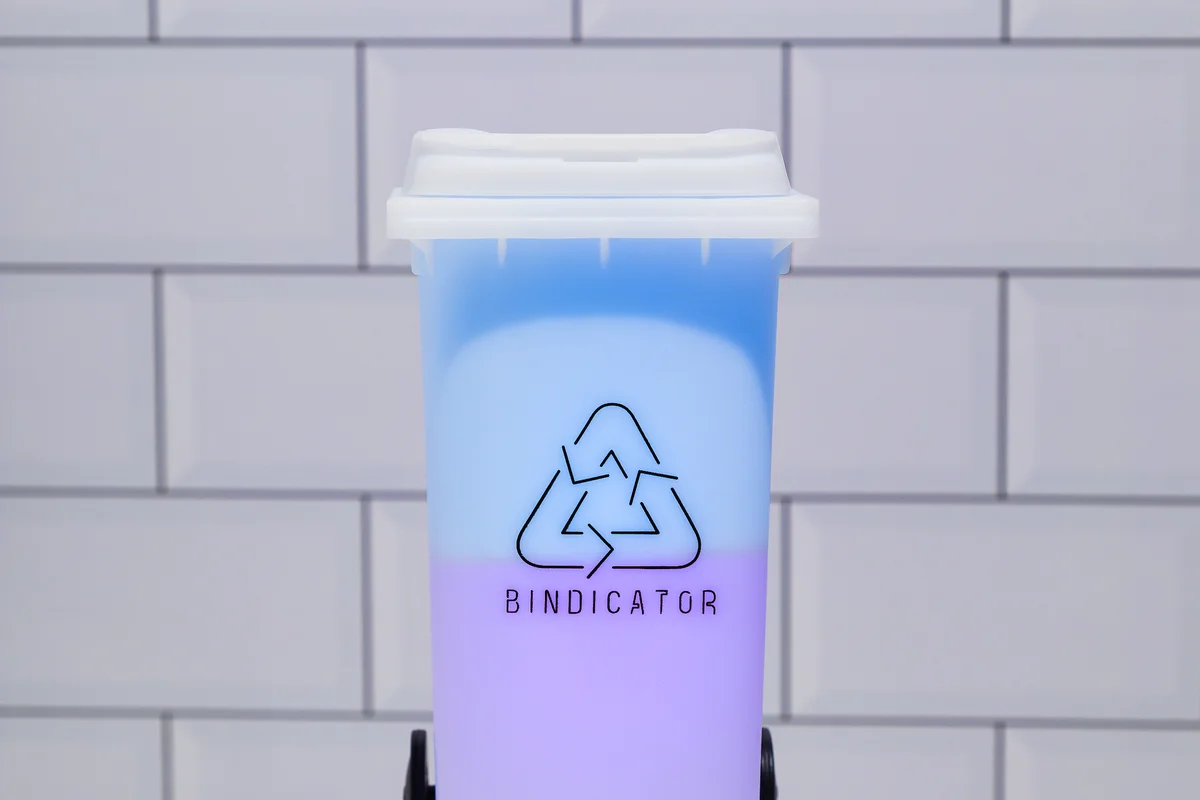
This is why we built Bindicator. It is a small lamp that sits on a kitchen shelf or counter. The night before collection, it glows in the colour of the bins that need to go out. green for recycling, brown for food caddy, black for general waste, or whatever combination your council uses. Anyone in the house can see it. When the bins are out, you tap the lid and the light switches off.
You set it up once through the app (about 2 minutes, then you can delete the app if you want), and it picks up your council's schedule automatically. That includes the Simpler Recycling changes. when your council updates the calendar, Bindicator updates with it. Bank holiday shifts are handled in the background. The light just shows the right bins on the right night.
If you live alone, a phone reminder is probably enough. If you share a house, live with family, or are tired of being the only person who knows which bin goes out, a visible cue everyone can see makes the new schedule a lot easier to live with.
For more on the wider topic, see our guides on UK bin day reminder apps and tools and why councils make bin schedules so confusing.