How to Never Forget Bin Night Again
7 Methods Ranked
It’s 10pm on a Sunday. You’re already in bed. And then it hits you: is it recycling week or green waste week?
If you’ve ever sprinted to the kerb in your pyjamas, frantically Googled your council’s collection calendar, or quietly put out the wrong bin and hoped for the best — you’re not alone. Forgetting bin night is one of those tiny, recurring domestic failures that somehow never stops being annoying.
The good news is there are plenty of ways to solve it. The bad news is most of them only work for one person in the household, which means the rest of the house is still in the dark (sometimes literally).
We’ve tested and ranked seven common bin night reminder methods. We scored each one on three things: how reliable it is, how much effort it takes to set up and maintain, and whether it works for everyone in the household — not just the person who set it up.
Here’s how they stacked up, from worst to best.
7. Asking Your Neighbours
Reliability
⬤○○○○
Setup effort
⬤○○○○
Whole household?
✘ Only you
The classic. You glance out the window on bin night, see what your neighbour has put out, and copy them. Zero effort. No technology required.
The problem? Your neighbours are doing the same thing. It’s a suburban version of the bystander effect — everyone waiting for someone else to go first. If your most reliable neighbour goes on holiday, the entire street falls apart.
It also does nothing over public holidays when schedules shift, and it’s completely useless if you live on a quiet street or your bins are collected before you wake up.
Verdict: Fine as a backup. Terrible as a system.
6. A Note on the Door
Reliability
⬤⬤○○○
Setup effort
⬤○○○○
Whole household?
✔ Everyone sees it
Write “BINS!” on a sticky note and slap it on the front door. Or write the schedule on a whiteboard in the hallway. Low tech, surprisingly effective for simple weekly collection.
The reason it ranks low: it doesn’t adapt. If your council has alternating fortnightly collections (and most do), a static note can’t tell you which week it is. You end up needing a second system to know whether it’s recycling or green waste, which defeats the purpose.
It does have one underrated advantage though — everyone in the house walks past it. It’s one of the few methods that doesn’t rely on a single person remembering to tell everyone else.
Verdict: Works for simple schedules. Breaks down the moment things alternate.
6. A Note on the Door
Reliability
⬤⬤○○○
Setup effort
⬤○○○○
Whole household?
✔ Everyone sees it
Write “BINS!” on a sticky note and slap it on the front door. Or write the schedule on a whiteboard in the hallway. Low tech, surprisingly effective for simple weekly collection.
The reason it ranks low: it doesn’t adapt. If your council has alternating fortnightly collections (and most do), a static note can’t tell you which week it is. You end up needing a second system to know whether it’s recycling or green waste, which defeats the purpose.
It does have one underrated advantage though — everyone in the house walks past it. It’s one of the few methods that doesn’t rely on a single person remembering to tell everyone else.
Verdict: Works for simple schedules. Breaks down the moment things alternate.
5. Fridge Magnet or Bin Chart
Reliability
⬤⬤⬤○○
Setup effort
⬤○○○○
Whole household?
✔ Visible to household
Some councils mail out colour-coded bin calendars. Some people make their own chart and stick it to the fridge. Others use a coloured clothes peg on a hook, flipping it each week to track which bin is next.
It’s genuinely clever and it works — as long as someone remembers to flip the peg or check the chart. The failure mode is human: you forget to update it after a public holiday shift, or the calendar falls behind the fridge and stays there for six months.
The household visibility is good, though. Anyone who walks into the kitchen can see it.
Verdict: Reliable if you maintain it. The peg trick is underrated.
4. Council App or SMS Reminder Service
Reliability
⬤⬤⬤○○
Setup effort
⬤⬤○○○
Whole household?
✘ Per person
Many councils now offer collection schedule lookups on their websites, and some provide push notifications or SMS reminders. There are also third-party services like Bin Reminder and apps like What Bin Day that centralise this.
When they work, they’re reliable. The data comes straight from the council, so public holiday changes are usually handled automatically. Some even let you set a reminder for the evening before.
The limitations: coverage is patchy (not every council is supported), you’re relying on a third party to maintain the integration, and it’s still just a notification on one person’s phone. The rest of the household has no idea unless that person tells them.
Verdict: Good if your council is supported. Still a one-person solution.
3. Phone Calendar Reminder
Reliability
⬤⬤⬤⬤○
Setup effort
⬤⬤○○○
Whole household?
✘ Only you
Set a recurring event in Google Calendar or Apple Calendar for each bin type: “Yellow bin — recycling” every other Tuesday, “Green bin — garden waste” on the alternating week, and general waste weekly. Set a reminder for 6pm the night before.
This is the most common approach for good reason. It’s free, it’s on a device you already check constantly, and the recurring events handle the alternating weeks for you once you set them up correctly.
The downside is obvious: it’s personal. Your housemate, partner, or teenager doesn’t get the reminder. You become the Bin Person — the one who always has to tell everyone else, or just do it yourself because it’s easier. And if you’re busy, on mute, or just swipe the notification away, it’s gone.
Verdict: Reliable for you. Useless for everyone else in the house.
2. Smart Speaker Routine (Alexa / Google Home)
Reliability
⬤⬤⬤⬤○
Setup effort
⬤⬤⬤○○
Whole household?
✔ If they’re in earshot
If you’ve got an Alexa or Google Home, you can set up a routine that announces the bins at a set time. “Reminder: it’s recycling bin night. Put out the yellow bin.” There are also Home Assistant integrations for the more technically inclined.
This is one of the better options because it’s audible — everyone in the room hears it. It’s also hands-free, which means you don’t have to check anything or swipe anything.
The downsides: setup is fiddly (especially for alternating weeks), you need to be home when it announces, and if the schedule changes over a public holiday you’ll need to manually adjust. Smart speaker routines are also notoriously annoying to edit once you’ve set them up.
Verdict: Great if you’re already in the smart home ecosystem. Overkill for most people.
1. Smart Bin Reminder Light
Reliability
⬤⬤⬤⬤⬤
Setup effort
⬤○○○○
Whole household?
✔ Everyone sees it
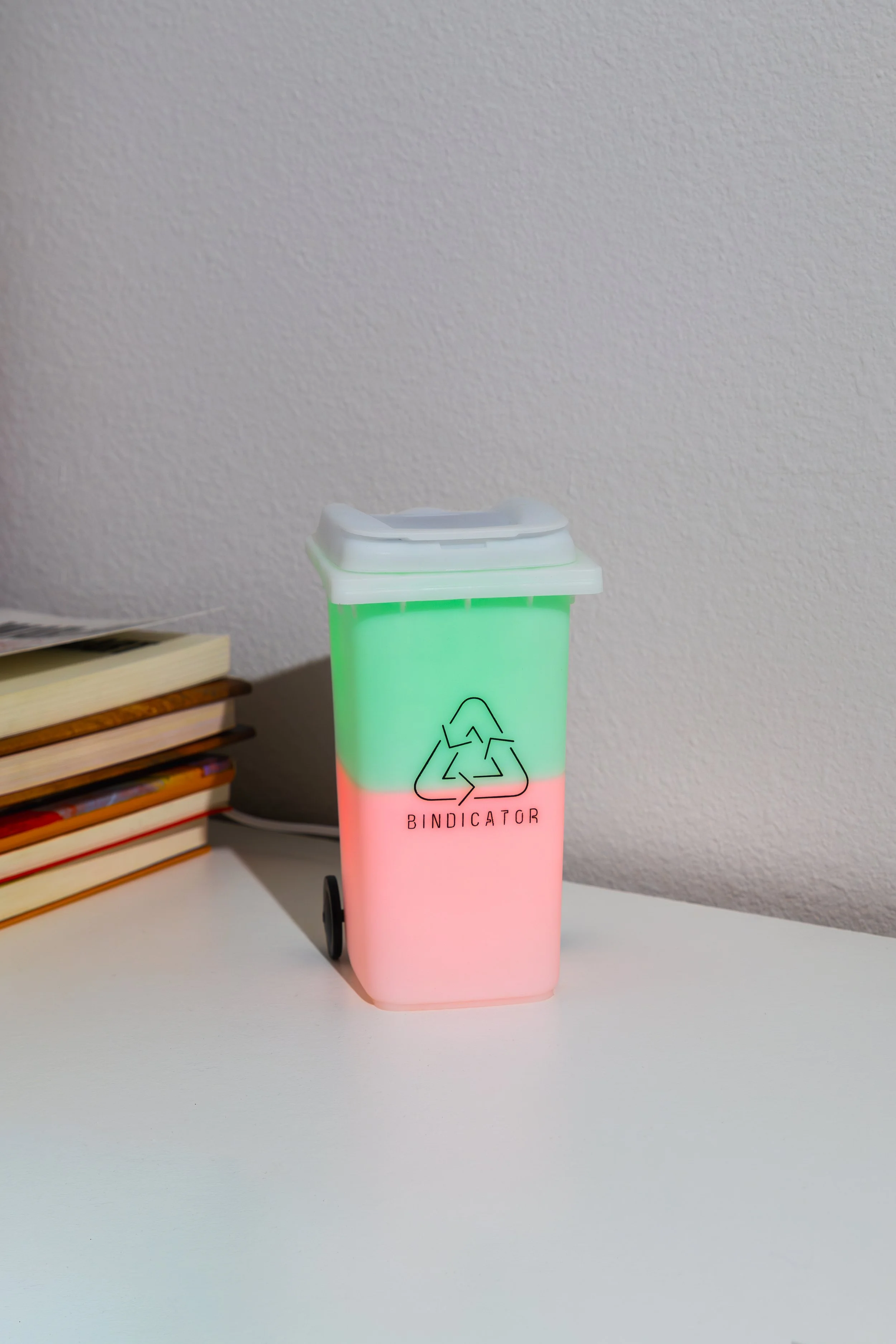
A dedicated physical light that sits somewhere visible in your home and glows the colour of the bins that need to go out. No notification to swipe away. No chart to update. No app to check. It’s just there, glowing green (or red, or yellow) the night before collection.
This is the approach we’re obviously biased about, because it’s exactly what we built Bindicator to do. But we built it precisely because we’d tried all of the methods above and they all had the same flaw: they only work for the person who set them up.
Bindicator sits on a kitchen bench or hallway shelf and lights up the night before bin day in the right colour. Everyone in the house sees it. There’s no app to check after the initial 2-minute setup. When someone takes the bins out, they tap the lid and the light switches off — so the rest of the household knows it’s been handled.
It costs A$35 (about £22 in the UK), plugs in via USB, and connects to your Wi-Fi to keep the schedule accurate through daylight savings changes and leap years. No batteries to replace, no subscription, no ongoing maintenance.
The key reason it ranks first: it’s the only method that communicates to the entire household passively, with zero ongoing effort from anyone. It’s also the only one where turning off the reminder is itself a signal to everyone else that the job’s been done.
Verdict: Set it once, forget about it. Works for every person in the house, every week, without anyone lifting a finger.

Never stand at the kerb wondering which bin to take out. Bindicator lights up the night before collection in your council’s bin colours - so you always know at a glance.
Loved by 700+ households across Australia and the UK.
✔ Works with any council schedule, any bin colours
✔ One-time 5-minute setup via the free app — then delete the app if you like
✔ Tap the lid to dismiss — no phone needed
✔ Compact design (15cm tall) fits on any shelf or bench
✔ Always on, always ready — powered by the included USB cable
✔ Ships to Australia and the UK
The gift they didn’t know they needed
For the housemate who always forgets, the parent who’s sick of checking, or the friend who just moved house. Bindicator is the kind of surprisingly useful gift people actually talk about.
Order your bin reminder indicator light today. Never again wonder which bin goes out tonight.
Australia:Flat-rate shipping calculated at checkout. Most orders arrive in 3–5 business days.
United Kingdom:International shipping available. Typical delivery in 7–12 business days.
Free returns within 30 days. 3-year no-questions-asked warranty.
The Real Problem Isn’t Remembering — It’s Communicating
Here’s what we’ve learned from talking to hundreds of Bindicator customers: the issue was never really about forgetting. Most people can figure out a way to remind themselves. The real issue is that the reminder only reaches one person, and then that person has to become the household bin coordinator. It’s a tiny, thankless job that somehow always falls on the same person.
The best solutions — whether it’s a chart on the fridge, a smart speaker announcement, or a glowing light on the bench — are the ones that make the information visible to everyone without anyone having to play messenger.
However you solve it, the goal is the same: never stand at the kerb in your pyjamas wondering which bin to take out, ever again.